
Software is a product: what changes with Directive (EU) 2024/2853
The new product liability directive explicitly includes software. We read it as a software house: what changes in the release cycle, maintenance, documentation and contracts, with the articles cited, not hearsay.
Software is a product: what changes with Directive (EU) 2024/2853
Software product liability. A software house's perspective
From 9 December 2026, software officially falls under civil liability for defective products. The European directive is already in place; Italy, like the other Member States, must transpose it by 9 December 2026. Here is what changes in the release cycle, maintenance and contracts, for those who develop and those who buy.
In summary: what changes with Directive (EU) 2024/2853
Directive (EU) 2024/2853 on product liability (PLD) extends civil liability to software from 9 December 2026. Those who develop, distribute or import software — including SaaS, AI and embedded software — may be held liable for damages caused by product defects, including the failure to apply critical security updates. The regime applies to both standalone software and software integrated into physical devices.
-
In force from 9 December 2026
Directive 2024/2853 applies to software products placed on the EU market after this date. The Italian transposition is still in progress.
-
Mandatory security updates
Failing to release critical security patches may constitute a product defect under the software PLD, resulting in civil liability.
-
Supply chain involved
Software product liability extends to developers, distributors and importers: every link in the supply chain may be held accountable.
-
Essential technical documentation
Software houses must maintain up-to-date procedural technical documentation to demonstrate product compliance and defend themselves in the event of litigation.
Directive (EU) 2024/2853: product liability for software from software houses
About Directive (EU) 2024/2853, the new Product Liability Directive (PLD), you have already read many analyses written by law firms, and they do their job: they explain what the regulation says. Here we do something different: we read it as a software house — what changes in the release cycle, in maintenance, in technical documentation, and in the contracts of those who build software and those who buy it. Software product liability is no longer an abstract topic: with Directive 2024/2853, software becomes a product in every respect, and the software house liability towards its own customers expands significantly. Those who do not distribute critical software security updates risk being held civilly liable for damages caused by product defects (PLD software).
This is not a theoretical exercise: in August 2026 we withdrew one of our healthcare SaaS products from the market also in light of this new product liability framework. We know what it means to do these calculations, because we did them on one of our own products.
This is the technical reading of someone who develops software, not legal advice. All cited references point to the official text published on EUR-Lex; the status of Italian transposition is stated below and at the bottom of the article.
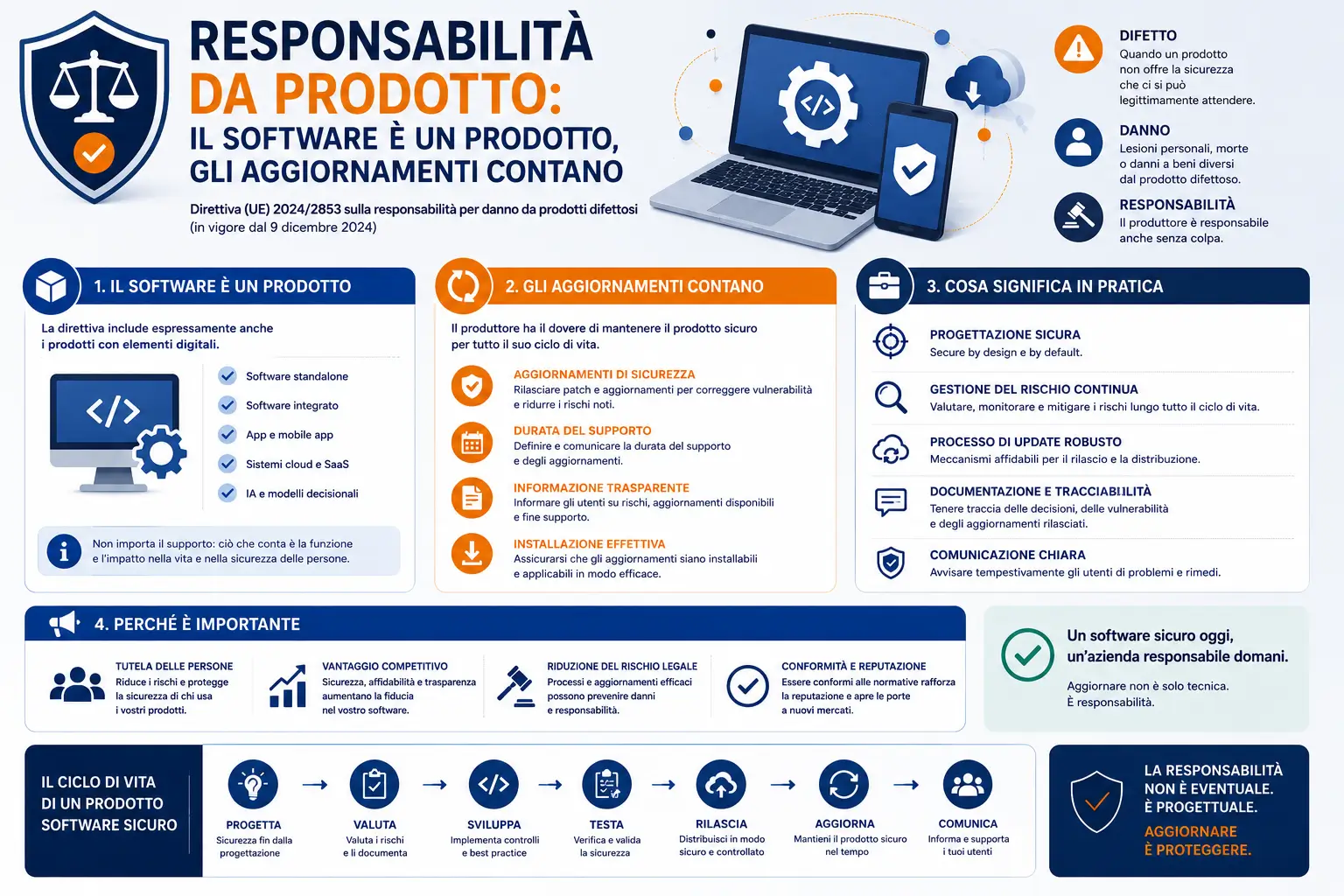
The software is officially a product
Article 4(1) of the directive defines a product as «any movable item» and specifies that the definition «includes electricity, files for digital fabrication, raw materials and software». Paragraph 3 adds the concept of a related service: a digital service integrated into or interconnected with a product «in such a way that its absence prevents the product from performing one or more of its functions» — the cloud backend without which the application does not work falls within this definition.
- Open source: the directive does not apply to free and open-source software «developed or supplied in the course of a non-commercial activity» (Art. 2, para. 2). The commercial distribution of open source, however, is not excluded.
- Temporal dividing line: the new rules apply to products «placed on the market or put into service after 9 December 2026» (Art. 2, para. 1). Software already on the market remains under the previous regime of Directive 85/374/EEC, repealed with effect from the same date (Art. 21).
Italy has not yet transposed the directive
Directive (EU) 2024/2853 is in force at European level, but it is a directive, not a regulation: it does not apply on its own. Each Member State must transpose it into its own legal system by 9 December 2026 (Art. 22). As of the publication date of this article, Italy has not yet adopted the transposition decree: the final rules — including national choices such as the development risks exemption under Art. 18 — will come with the decree. We will update this content when that happens.
When software is «defective» and when it is not
The general criterion is safety, not quality: a product is defective «if it does not provide the safety that a consumer can legitimately expect or that is required by Union or national law» (art. 7, c. 1). Software with disappointing performance, a questionable UX or features inferior to a competitor is not, for that reason, a defective product: the directive itself states it — a product «is not considered defective for the sole reason» that a better one exists or will be released, «including updates and improvements to it» (art. 7, c. 3).
Among the circumstances that the judge must assess (art. 7, c. 2), three directly concern developers:
-
Machine learning
The product's ability «to continue learning or acquiring new capabilities» after being placed on the market is among the defectiveness criteria (let. c).
-
Interconnection
The reasonably foreseeable effects of other products that can be expected to be used together with the product are taken into account (let. d).
-
Cybersecurity
«The relevant safety requirements for the product, including cybersecurity requirements» are factored into the assessment (let. f): the direct bridge with the Cyber Resilience Act.
The novelty that affects the release cycle: not updating is a responsibility
The classic supplier defence has always been: «the defect did not exist when I delivered» (art. 11, c. 1, lett. c). The directive retains it, but pulls the ground from under its feet precisely where software lives. When the product is under the manufacturer's control, the exemption does not apply if the defect is due to one of these four elements (art. 11, c. 2):
-
Related service
The digital service without which the product cannot perform its functions — the cloud backend, for example.
-
Software and updates
Defects introduced by software, updates or improvements provided after delivery.
-
Missing updates
"The absence of software updates or improvements necessary to maintain security" (letter c): the point that changes the profession.
-
Substantial modification
A substantial modification of the product while it is under the manufacturer's control.
Failing to release necessary security updates becomes an independent source of civil liability, not merely a bad practice. And «manufacturer's control» includes the technical ability to provide updates (art. 4, p. 5): for a SaaS, or for any software with an update channel, control exists by definition.
The operational consequence is concrete: the maintenance period stops being a commercial optional. Those who sell software, or those who buy it, need the contract to state who releases security patches, for how long, and with what response times. This is the same direction as the «support period» of the Cyber Resilience Act: the two regulations, one on the regulatory level and one on the civil liability level, push toward the same point. In our custom offering maintenance is already an explicit contractual item, not a line at the bottom of the quote: from December 2026 it will simply be indispensable for everyone.
Who is responsible in the supply chain
The order of liable parties is established by Article 8: the manufacturer of the product is liable; the manufacturer of the defective component integrated under the control of the former is liable — and third-party software integrated into a product is a component (Art. 4, p. 4); for non-EU manufacturers, liability cascades to the importer, authorised representative, or logistics provider. Whoever substantially modifies a product outside the manufacturer's control and places it back on the market becomes its manufacturer in turn (Art. 8, para. 2).
For those who develop on commission or supply components, two provisions are worth more than many contractual clauses:
- The instructions defence (Art. 11, para. 1, let. f): the component manufacturer is not liable if the defect is due to «the design of the product into which it was integrated» or «the instructions given by the product manufacturer». Translated into practical terms: documenting the requirements and instructions received from the client is not bureaucracy — it is a legal defence. Meeting minutes, signed specifications, tracked decisions: that material may one day be worth more than the code itself.
- The clause for small software houses (Art. 12, para. 2): whoever integrates a software component has no right of recourse against the component manufacturer if the latter was a micro or small enterprise and the waiver of recourse was «contractually agreed». The directive itself provides that this protection can be negotiated: if you are a small company supplying components to a larger integrator, this clause must be understood before signing.
What compensation really covers (and what remains in the contract)
Here the directive is stricter than newspaper headlines suggest. Article 6 limits recoverable damage to three categories:
- death or personal injury, «including psychologically recognised damage from a medical point of view»;
- damage to or destruction of property, but with the explicit exclusion of the defective product itself and of «goods used exclusively for professional purposes»;
- destruction or corruption of data, but only data «not used for professional purposes».
The consequence for B2B is significant: damage to the customer's data and business assets does not fall under product liability — it remains a matter of contract, where liability and caps can be negotiated. What always applies is damage to the person: the end user, the consumer, the patient. This is why those handling data or functions that affect natural persons (the healthcare sector being the textbook example) must make these calculations more carefully than anyone else.
On the contractual front, the boundary is clear: towards the injured party, product liability «shall not be limited or excluded […] by contractual provision» (Art. 15). What remains negotiable, however, is the allocation between economic operators, as illustrated by the waiver of recourse clause in Art. 12, para. 2. As for timeframes: the right is time-barred after 3 years from when the injured party becomes aware of the damage, the defect and the liable party (Art. 16), with a cap of 10 years from the placing on the market — which however restarts in the event of a substantial modification of the product — and 25 years for long-latency injuries (Art. 17).
Technical documentation becomes procedural material
Two often overlooked articles are the ones that will most change the way of working. The first is Article 9: upon a plausible request from the injured party, the defendant is required to disclose the evidence at their disposal (with protections for trade secrets). The second is Article 10, which introduces significant presumptions: defectiveness is presumed if the defendant fails to disclose the requested evidence, if the product violates mandatory safety requirements, or in the case of an «obvious malfunction» during foreseeable use; and when the evidence is technically too complex for the claimant, probability suffices (para. 4). All rebuttable presumptions (para. 5), but rebutting them requires material.
Taken together, the two articles say one thing only to developers: tidy repositories, changelogs, security advisories, documented architectural decisions and tracked tests are no longer just good engineering — they are the defence. Anyone who cannot show how they managed the security of their software starts with a presumption against them.
One last open variable is national: Article 18 allows Member States to derogate from the exemption for «development risks» (the state of the art that did not allow the defect to be discovered), with notification to the Commission by 9 December 2026. Whether and how Italy will exercise this option will be stated in the implementing decree — this is one of the points we will be monitoring.
What changes in practice: the developer's checklist
Maintenance written into the contract
art. 11, c. 2
Who releases security patches, for how long, and within what timeframes. After 9 December 2026, software delivered and never updated again is a risk for both parties.
Tracked lifecycle
artt. 9-10
Changelogs, security advisories, documented architectural decisions, tracked tests: this is the material used to rebut evidentiary presumptions.
Documented client instructions
art. 11, c. 1, lett. f
In custom and subcontracted work, signed analysis reports and specifications are not red tape: they are a legal defence explicitly provided for by the directive.
Cybersecurity as a product requirement
art. 7, c. 2, lett. f
Defectiveness is tied to applicable cybersecurity requirements: the work done for the Cyber Resilience Act also counts on the civil liability front.
Recourse clauses negotiated knowingly
art. 12, c. 2
Especially if you are — or buy from — a micro or small software company: waiving the right of recourse against the component supplier is expressly provided for and must be negotiated before signing.
Clear damage scope
art. 6
Damage to business assets and data remains contractual territory; personal injury always falls under the directive. Where software affects natural persons, the calculations must be made beforehand, not after.
The last point for us is not a slogan: it is the account we ran on MedicHub, and it is the reason why today we design every software, ours or our clients', with maintenance and documentation as part of the product, not as an add-on. No supplier can «make you compliant» by contract: the responsibility remains with whoever places the product on the market. What a good supplier can do is deliver software that is built, documented and maintained in a way that holds up under this framework.
Frequently asked questions
Yes: Directive (EU) 2024/2853 explicitly includes it in the definition of product (Art. 4, p. 1), and a digital service without which the product cannot function falls within the scope as a 'related service' (p. 3). Excluded only is free and open-source software provided in a non-commercial activity (Art. 2, p. 2).
To products placed on the market or put into service after 9 December 2026 (Art. 2, p. 1), which is also the national transposition deadline (Art. 22). Software already on the market remains under the previous regime of Directive 85/374/EEC.
When the product is under the manufacturer's control, the defence 'the defect did not exist at the time of delivery' does not apply if the defect stems from the lack of updates necessary to maintain security (Art. 11, p. 2, let. c). The maintenance period must be defined by contract.
Not through this directive: defectiveness is a matter of safety, not quality (Art. 7, p. 1), and a product is not defective merely because a better one exists (p. 3). Furthermore, damage to goods and data used for professional purposes is excluded from compensation (Art. 6): B2B remains a contractual matter.
Towards the injured party, no: Art. 15 prohibits limiting or excluding it contractually. The apportionment between economic operators is instead negotiable: Art. 12, p. 2 expressly provides for the waiver of the right of recourse against micro and small enterprises supplying software components.
Three verifiable things: who releases security updates and for how long; what technical documentation accompanies the product (changelog, advisories, tracked decisions); how liability and recourse are regulated in the contract. No supplier can 'make you compliant': they can, however, deliver software built and maintained to withstand this framework.
Sources and transposition status. This article is based on the official text of Directive (EU) 2024/2853 published on EUR-Lex (OJ L of 18.11.2024), verified in August 2026. As of the publication date, the Italian transposition decree has not yet been adopted: the deadline is 9 December 2026 (Art. 22) and we will update this content once transposition is finalised, including national choices on Art. 18. This content represents the technical reading of software developers and does not constitute legal advice: for decisions on contracts and liability, please consult a lawyer.
Are you signing a software development contract?
Let's talk about maintenance, documentation and liability before they become a problem: a technical consultation with those who have been building and maintaining software since 2007.
