
Cyber Resilience Act: the three dates that matter and the transitional period nobody talks about
The Cyber Resilience Act (Reg. EU 2024/2847) does not have a single application date: it has three. And the transitional provision of Art. 69 hides the point that almost nobody talks about: software already on the market escapes the technical requirements as long as it is not substantially modified, but it does not escape the vulnerability reporting obligations, which start on 11 September 2026. A technical reading from those who build software: scope, the SaaS boundary, SBOM and the support period, with cited articles.
The Cyber Resilience Act does not start in 2027
Reg. (EU) 2024/2847: three application dates, a transitional period that almost no one reads, and reporting obligations starting on 11 September 2026 read by those who build and maintain software.
This is a technical reading, not legal advice: every date and every obligation mentioned refers to the article of the regulation from which it originates.
In summary: what it provides and from when
The Cyber Resilience Act is the European regulation on cybersecurity of «products with digital elements»: software included. It is a regulation, not a directive: it applies directly, without national transposition (EU Reg. 2024/2847). The date everyone cites — December 2027 — is just one of the three provided, and for those who already have software on the market it is not even the first one that matters.
- Three application dates (art. 71): conformity assessment bodies from 11 June 2026, manufacturers' reporting obligations from 11 September 2026, everything else from 11 December 2027.
- Software already on the market remains outside the technical requirements as long as it does not undergo a «substantial modification» — but vulnerability reporting obligations apply to all in-scope products (art. 69).
- Pure SaaS is out of scope: the cloud falls within scope only when it is a functional part of a product (art. 3).
- Free software is not exempt if provided in the course of a commercial activity (art. 3).
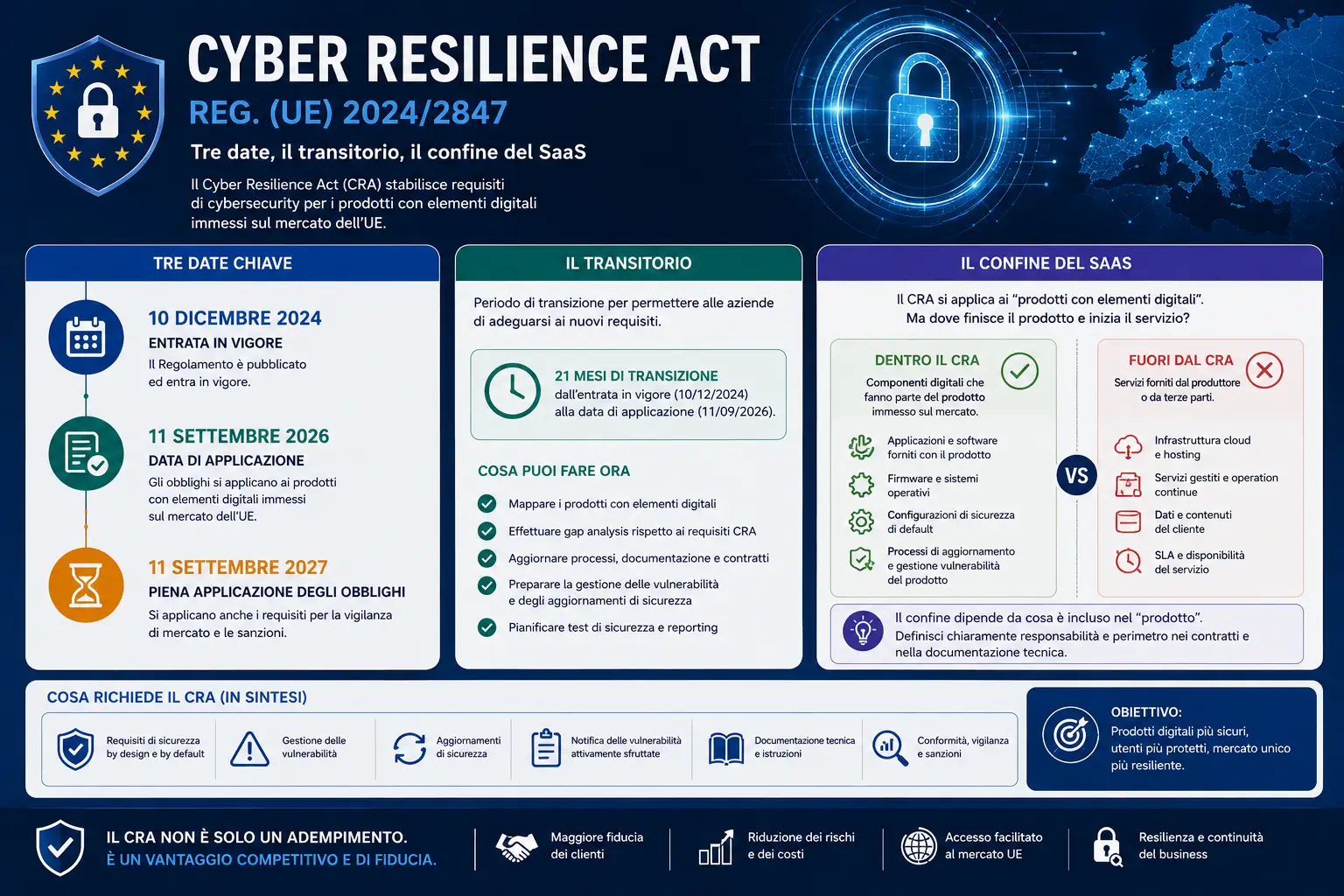
When does the Cyber Resilience Act really apply?
Art. 71 does not set a single deadline: it staggers the application across three moments. Reading only the last date — the one that appears in all headlines — means planning around the only one of the three that comes last.
11 June 2026
Conformity assessment bodies
Chapter IV applies: the conformity assessment bodies machinery comes into operation (art. 71).
11 September 2026
Reporting obligations
The manufacturers' reporting obligations under art. 14 come into effect — fifteen months before the date everyone cites (art. 71).
11 December 2027
General application
The remainder of the regulation applies: essential requirements, conformity assessment, documentary obligations (art. 71).
The transitional provision no one talks about (art. 69)
The question that every company with software already on the market asks itself is: «do I have to redo everything?». Art. 69 gives an answer in two halves, and almost everyone only tells the first one.
-
Technical requirements: only if you modify
Products placed on the market before 11 December 2027 are subject to the requirements ONLY if they undergo a 'substantial modification' (art. 69, c. 2). Existing software in the field does not need to be redesigned as long as it remains unchanged.
-
Reporting obligations: for everyone, and earlier
The reporting obligations under art. 14 apply to ALL in-scope products already on the market (art. 69, c. 3) — and they start on 11 September 2026, not in 2027.
Translated into decisions: existing software escapes technical requirements until it is substantially modified, but it does not escape the obligation to report actively exploited vulnerabilities. Those who already have products on the market should not be asking «what do I do by 2027?»: they should be asking who, within the company, notices an exploited vulnerability and reports it — from September 2026. This is a matter of process and monitoring, not of rewriting code. And for those planning a significant change to an existing product, the date of the change becomes the date on which the requirements kick in: it must be included in the project plan, not discovered afterwards.
What falls within the scope (and what doesn't)
The regulation applies to «products with digital elements» whose intended purpose involves a data connection, direct or indirect (art. 2, c. 1): application software, firmware, connected devices. Excluded are products already covered by more specific sectoral rules (art. 2, cc. 2-4):
-
Medical devices
Already covered by MDR regulations 2017/745 and 2017/746.
-
Vehicles
Covered by dedicated type-approval regulations.
-
Civil aviation
Dedicated sector-specific rules, outside the CRA scope.
-
Marine equipment
Covered by its own sector-specific regulations.
Does SaaS fall under the CRA? It depends on what it does
The boundary lies in the definitions of Art. 3: the regulation covers software and «the related remote data processing solutions», defined as processing whose absence would prevent the product from performing one of its functions. In practice: the cloud falls within the scope when it is a functional part of a product — the backend without which the app does not work — while a pure SaaS sold as a standalone service does not meet the definition (for that, the reference is rather NIS2). It is a distinction to be handled with precision, because the same architecture can fall on one side or the other depending on how the product is packaged and sold.
Pay attention also to free software: making available on the market covers the supply «for consideration or free of charge [...] in the course of a commercial activity» (Art. 3). A free component distributed as a commercial lever for a paid service falls within commercial activity — a zero price is not a shortcut to exit the scope.
How we position ourselves with respect to these regulations, product by product, is something we have put in black and white on the Security and compliance page.
SBOM and support period: what changes in what you deliver
Two definitions in art. 3 say, better than any commentary, where the regulation is heading.
The SBOM — «software bill of materials» — is the formal register of software components and their relationships along the supply chain. For developers it means something concrete: knowing at any moment which dependencies are inside what you have delivered, in a format that can be produced on demand. Anyone who today could not list the libraries of a project delivered three years ago has already found their first construction site.
The «support period» is the period during which the manufacturer guarantees vulnerability management (Annex I, Part II). It is the same direction as the new product liability directive, where failing to provide security updates becomes a source of civil liability: software ceases to be a deliverable and becomes a commitment over time. In custom development projects, this is the reason why maintenance is not an optional add-on to the quote: it is the part of the product that the law is beginning to require.
Why you won't find the penalty amounts here
Many articles on the Cyber Resilience Act open with the fines. We don't mention them, for a simple reason: we have not yet verified Chapter VII on the text of the regulation, and our rule is not to publish regulatory figures read second-hand. The same applies to two points that deserve a dedicated reading: the qualification of software developed under a single commission and the implementing acts on the classes of important and critical products. When we have verified them, we will update this article.
In the meantime, the right motivation for dealing with the CRA is not the fear of a fine: it is that its requirements — vulnerability management, guaranteed updates, transparency on components — are becoming the criterion by which customers choose their suppliers, even before the law makes them mandatory. Those who buy software have already started asking "who maintains it, and how".
Frequently Asked Questions on the Cyber Resilience Act
It is the European regulation (EU 2024/2847) that sets cybersecurity requirements for «products with digital elements»: software, firmware and connected devices. Being a regulation and not a directive, it applies directly in all Member States, without national transposition.
In three stages (art. 71): from 11 June 2026, Chapter IV on conformity assessment bodies; from 11 September 2026, manufacturers' reporting obligations (art. 14); from 11 December 2027, the rest of the regulation.
With the technical requirements only if it undergoes a «substantial modification» after 11 December 2027 (art. 69, para. 2). The vulnerability reporting obligations, however, apply to all in-scope products already on the market (art. 69, para. 3) and take effect on 11 September 2026.
A pure SaaS sold as a standalone service does not: the regulation covers remote data processing only when its absence would prevent the product from performing one of its functions (art. 3). Cloud acting as a functional backend for a product is included; a standalone service falls instead within the NIS2 scope.
No, if it is provided in the course of a commercial activity: making available on the market covers supply «for consideration or free of charge» (art. 3). A free component used as a commercial lever for a paid service falls within the scope.
Does your software have a maintenance plan or just a test?
The CRA makes explicit what serious projects already do: tracked dependencies, managed vulnerabilities, updates guaranteed over time. If you want to understand what this means for your product, let's talk about it.
Sources and methodological note
Primary source: Reg. (EU) 2024/2847 (Cyber Resilience Act), text published on EUR-Lex; references verified on 3 August 2026. Articles cited: 2, 3, 14, 69, 71; Annex I, Part II. The regulation is directly applicable: no national transposition is required.
This article reflects the technical perspective of a software developer, not legal advice: for application to your specific case, you should seek the opinion of a qualified professional. The regulatory framework is evolving — some parts of the regulation (penalties, implementing acts) have not yet been verified by us against the text and are therefore not cited. Information accurate as of the publication date.
