
How I Use Artificial Intelligence in Software Development
How I integrate artificial intelligence into my daily software development workflow. From code completion with GitHub Copilot to custom AI agents integrated in MedicHub and AlesLab CMS.
How we use artificial intelligence in software development
GitHub Copilot, Claude, custom AI agents, RAG and the MCP protocol in AraLith's day-to-day development work
AI in our work: not a tool, a capability multiplier
At AraLith, a software house in the province of Rome, active since 2007, we use artificial intelligence as a capability multiplier, not as a substitute for reasoning. We have been developing software since 2007, and in recent years AI has changed the way we work: we explore more design alternatives, check code with more controls and tackle the hard problems earlier.
It is not about pressing a button and receiving finished software. It is an ongoing collaboration: we bring the business context, the architectural constraints and critical judgement; AI brings speed in exploring solutions and checking code.
In this article we describe how we integrate GitHub Copilot, Anthropic's Claude, custom AI agents and the MCP protocol into the development of our own products (AraLith COS, OreFattura, Mailable, AralithPulse) and of client projects. AI is a tool of our development work, not necessarily a feature of the software we deliver: MedicHub, the management system for dental practices we built, contains no artificial intelligence.
At a glance
-
Since 2007, in the province of Rome
AraLith, a software house in the province of Rome, active since 2007, uses artificial intelligence as a capability multiplier, not as a substitute for reasoning.
-
The tools
GitHub Copilot for real-time code completion, Anthropic's Claude for analysis and architectural design, custom AI agents and the MCP protocol.
-
Where we use it
In the development of our own products (AraLith COS, OreFattura, Mailable, AralithPulse) and of client projects.
-
Decisions stay with people
We bring the business context, the architectural constraints and critical judgement; AI brings speed in exploring solutions and checking code.
-
MedicHub without AI
MedicHub, the management system for dental practices built by AraLith, neither contains nor calls artificial intelligence models: it opens up to external assistants only through an MCP server.
Developing software since
AI tools used daily
tools in the MedicHub MCP server
Own SaaS products
Which AI tools do we use every day?
Each tool has a precise role in our work: GitHub Copilot for real-time code completion, Claude for analysis and architectural design, custom agents for the specific tasks of our projects.
-

GitHub Copilot
Intelligent code completion, Copilot Chat to generate complete implementations and run inline code reviews in the IDE.
-

Claude by Anthropic
Architectural analysis, debugging complex problems, code review and reasoning about business requirements.
-
Custom AI agents
Custom agents with tool use for specific tasks: generating and reviewing SEO content, code checks, content optimisation.
-
RAG vector search
Retrieval Augmented Generation to answer questions about specific documents with verifiable sources and precise context.
-
MCP protocol
Model Context Protocol to connect AI to external tools: CMS, databases, APIs, file systems. We use it in the AraLith COS MCP server and in the MedicHub one.
-
Human oversight
AI proposes, we decide. Every output is assessed critically: quality, security, fit with the real requirements.
How do we work with AI every day?
Every working day at AraLith is organised around constant collaboration with AI. It is not a rigid process, but a flow refined over time through daily use, in four recurring moments.
-
Design and architecture
Before writing code we discuss the architecture with Claude: data structures, relationships between entities, API contracts, patterns. We compare several variants and choose the most maintainable one.
-
Code completion
GitHub Copilot completes entire logical blocks; with Copilot Chat we describe in natural language the methods, classes and tests to write. Less time on boilerplate, more time on business logic.
-
Assisted debugging
When facing a complex bug we share code and traceback with Claude to analyse the causes, assess possible fixes and understand why the problem arose.
-
Review and testing
Before every commit, an AI-assisted review flags vulnerable security patterns, possible optimisations and edge cases not covered by tests. The decision stays ours.
How we use AI in AraLith COS
AraLith COS is the CMS we built, with a visual page builder. In the COS, AI is present both in the development cycle and in some features offered to CMS users, which propose content and changes to be reviewed before publication.
-
AI page builder
AI agents that generate complete pages from a text brief, following the component structure and the project's SEO guidelines.
-
SEO optimiser
SERP analysis, keyword suggestions, automatic optimisation of title tags, meta descriptions and the H1-H6 structure of pages.
-
AI media metadata
Visual analysis of images with Claude Vision to automatically generate SEO-optimised alt text, titles and descriptions.
-
Content generator
Content generation for blog posts, service pages and product descriptions while keeping the brand's voice and style.
MedicHub: no AI in the management system, an MCP server with the practice's rules
MedicHub is the management system for dental practices that AraLith designed and built, now presented as a case study. MedicHub neither contains nor calls artificial intelligence models: AI helped us write its code, as in all our projects, but it is not a feature of the management system. MedicHub opens up to external assistants only through an MCP server, with rules set by the practice. The technical account of how we built MedicHub goes into the details.
-
29 tools in 4 groups
The MedicHub MCP server exposes 29 tools: Configuration (9), Scheduling (5), Administration (9) and Clinical data (6). 21 tools read, 8 write.
-
Writes to confirm
Appointments, diary entries, forms and templates created by an assistant are held for confirmation by default; quotes are created as drafts.
-
Tools off by default
Each tool stays disabled until the practice enables it, one by one. Access goes through OAuth 2.1 with PKCE.
-
Patients as «patient N»
The tools refer to patients with the pseudonym «patient N» and a link to the record in the management system. MedicHub makes no diagnoses and gives no clinical suggestions.
What really changes with AI in our work?
We do not publish time-saving percentages: we have not measured them with a verifiable method. What we can do is describe what has changed in the way we work.
-
More time on logic
Code completion and generation of repetitive code cut the time spent on boilerplate and leave more room for business logic.
-
More checks on the code
An AI-assisted review before every commit helps spot vulnerable security patterns and edge cases not covered by tests; the final decision stays ours.
-
Focus on the hard problems
By delegating repetitive tasks to AI, we focus our time on architecture, user experience and product decisions that require human experience.
Frequently asked questions about AI in development
No, but it will profoundly change their role. AI is very good at generating standard code and solving well-defined problems, but it struggles with ambiguous requirements, strategic architectural decisions and understanding the business context. Programmers who know how to work with AI will be much more productive than those who do not use it.
GitHub Copilot is optimised for real-time code completion in the IDE: it suggests lines and blocks of code as you type. Claude is better suited to long conversations, architectural analysis, debugging complex problems and reasoning about requirements. At AraLith we use them together: Copilot for speed, Claude for depth.
MCP (Model Context Protocol) is a standard that lets AI models connect to external tools in a controlled way. With MCP an assistant can work on CMSs, databases, project files and APIs, with the permissions decided by whoever runs the system. AI thus goes from a simple chatbot to an assistant with access to the real context of the project.
RAG (Retrieval Augmented Generation) is a technique that lets AI answer using specific documents as context. In practice, technical documentation, project specifications or a company knowledge base are indexed in a vector database; the AI retrieves the relevant passages before answering, so the answers can be checked against the sources.
No. MedicHub, the management system for dental practices built by AraLith, neither contains nor calls artificial intelligence models and does not process health data with AI. The only link with external assistants is an MCP server: the tools are off by default, patients appear as «patient N», and whatever an assistant writes is held for confirmation or saved as a draft.
Want to bring AI into your development workflow?
Tell us about your project: together we will assess where AI really helps development and where well-designed traditional software is needed.
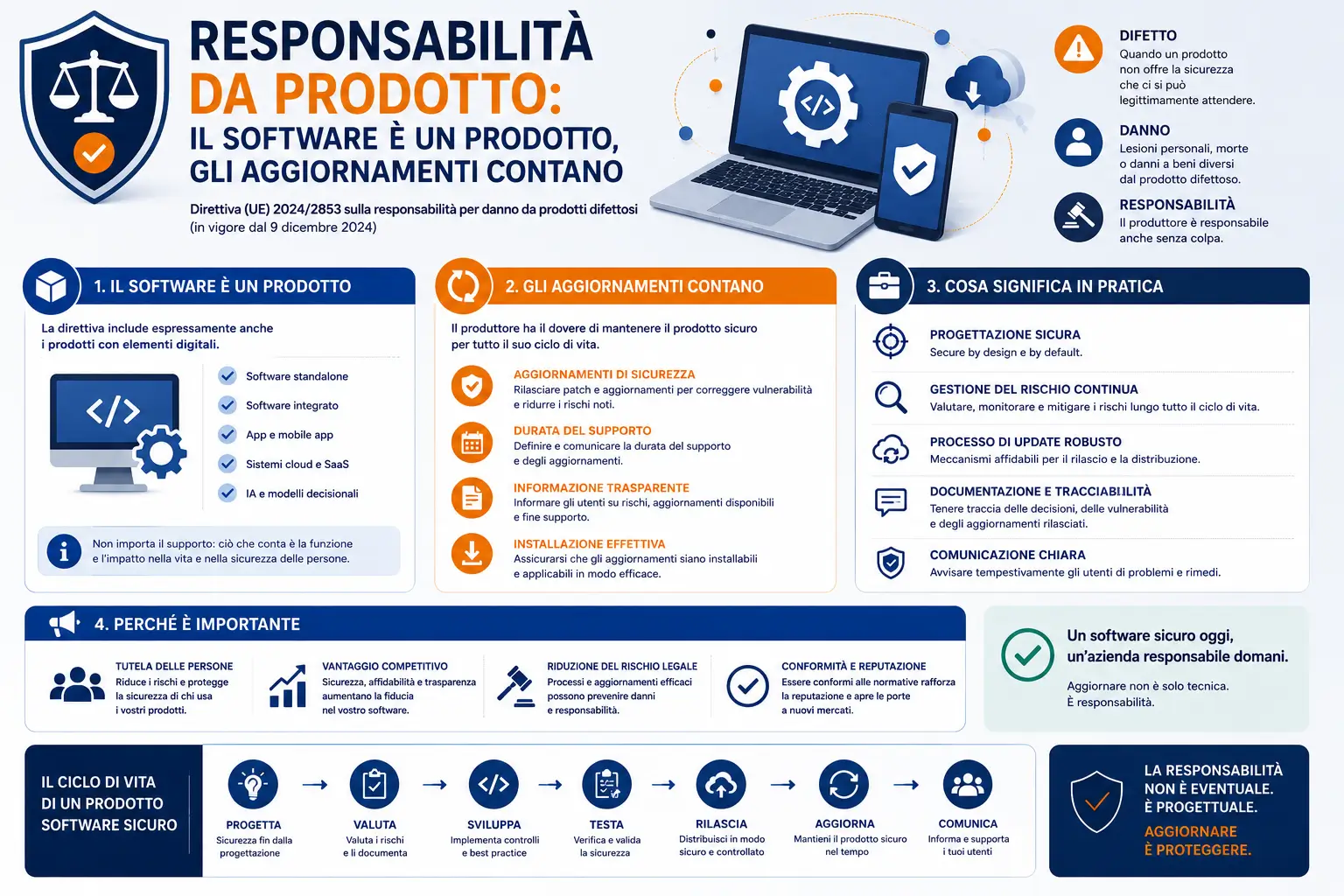
Software is a product: what changes with Directive (EU) 2024/2853
The new product liability directive explicitly includes software. We read it as a software house: what changes in the release cycle, maintenance, documentation and contracts, with the articles cited, not hearsay.
Read
Developing management software: how a custom project really works
The five phases of a management software development project told from the perspective of the client: what happens in each phase, what determines the timeline, what your company needs to do while work progresses, and the seven questions to ask the vendor before signing.
Read