01
Intended purpose and CE marking
Regulation (EU) 2017/745
If the tool provides clinical information, check that it is a CE-marked medical device for that intended purpose, with the class declared by the manufacturer.

Informational guide
Artificial intelligence in dentistry is a support tool: under Italian law the clinical decision always stays with the clinician, and software that provides information for diagnostic or therapeutic decisions is a medical device. This guide by AraLith, a software house in the province of Rome, active since 2007, summarises the rules in force and the checks to make before adopting a tool.

Key facts
Artificial intelligence in the dental practice is governed by three sets of rules: the Italian AI law, the Medical Device Regulation and the AI Act, plus the GDPR.

The artificial intelligence tools that reach a dental practice belong to two families with different rules: clinical tools, which provide information for diagnostic or therapeutic decisions, and organisational tools, which help with scheduling, quotes and communications. The intended purpose declared by the manufacturer decides which family a piece of software belongs to.
They are medical devices
Software that provides information for diagnostic or therapeutic decisions, for example on X-rays: under Regulation (EU) 2017/745 it is a medical device of at least class IIa (Annex VIII, Rule 11). It should be chosen among CE-marked products for that intended purpose.
They still process health data
Assistants for scheduling, quotes and communications: software intended for general purposes, even when used in a healthcare setting, is not a medical device (Regulation (EU) 2017/745, Recital 19). Patient data, however, remains a special category of personal data (GDPR, Art. 9).
The rules on artificial intelligence in dentistry set one principle and three practical rules: AI is a support and the decision stays with the clinician; the patient must be informed; a tool with clinical purposes is a medical device; health data requires the reinforced safeguards of the GDPR.
AI systems in healthcare are a support in prevention, diagnosis, treatment and therapeutic choice; the decision always belongs to medical professionals (Law 132/2025, Art. 7(5)).
The data subject has the right to be informed about the use of artificial intelligence technologies (Law 132/2025, Art. 7(3)). The law does not set its form or method.
Software intended for diagnosis, monitoring or treatment is a medical device (Regulation (EU) 2017/745, Art. 2(1)); if it provides information for diagnostic or therapeutic decisions it is at least class IIa (Annex VIII, Rule 11).
The intended purpose is also derived from promotional and sales material (Regulation (EU) 2017/745, Art. 2(12)): a website that attributes diagnostic functions to software also attributes them to it in the eyes of the law.
An AI system that is itself a medical device subject to assessment by a notified body is high-risk under the AI Act (Regulation (EU) 2024/1689, Art. 6(1) and Annex I).
Data concerning health is a special category of personal data (GDPR, Art. 9): the practice remains the data controller even when it uses an external provider (Art. 28).
Before adopting an artificial intelligence tool, a dental practice should check five points: intended purpose and marking, the data path, minimisation, the clinician's role and patient information. These checks derive from the rules cited above; they are not guarantees of compliance.
Regulation (EU) 2017/745
If the tool provides clinical information, check that it is a CE-marked medical device for that intended purpose, with the class declared by the manufacturer.
GDPR, Art. 28
Who processes the data, in which country, under which data processor agreement and with which retention periods.
GDPR, Art. 25
The tool should receive only the data it needs, pseudonymised where possible; large-scale processing of health data may require a data protection impact assessment (GDPR, Art. 35).
Law 132/2025, Art. 7
Every clinically relevant result remains a proposal to be validated: the workflow must make it clear that the decision belongs to the clinician.
Law 132/2025, Art. 7(3)
How the practice informs the patient about the use of artificial intelligence: form and method are defined with your own privacy consultant.
Case study
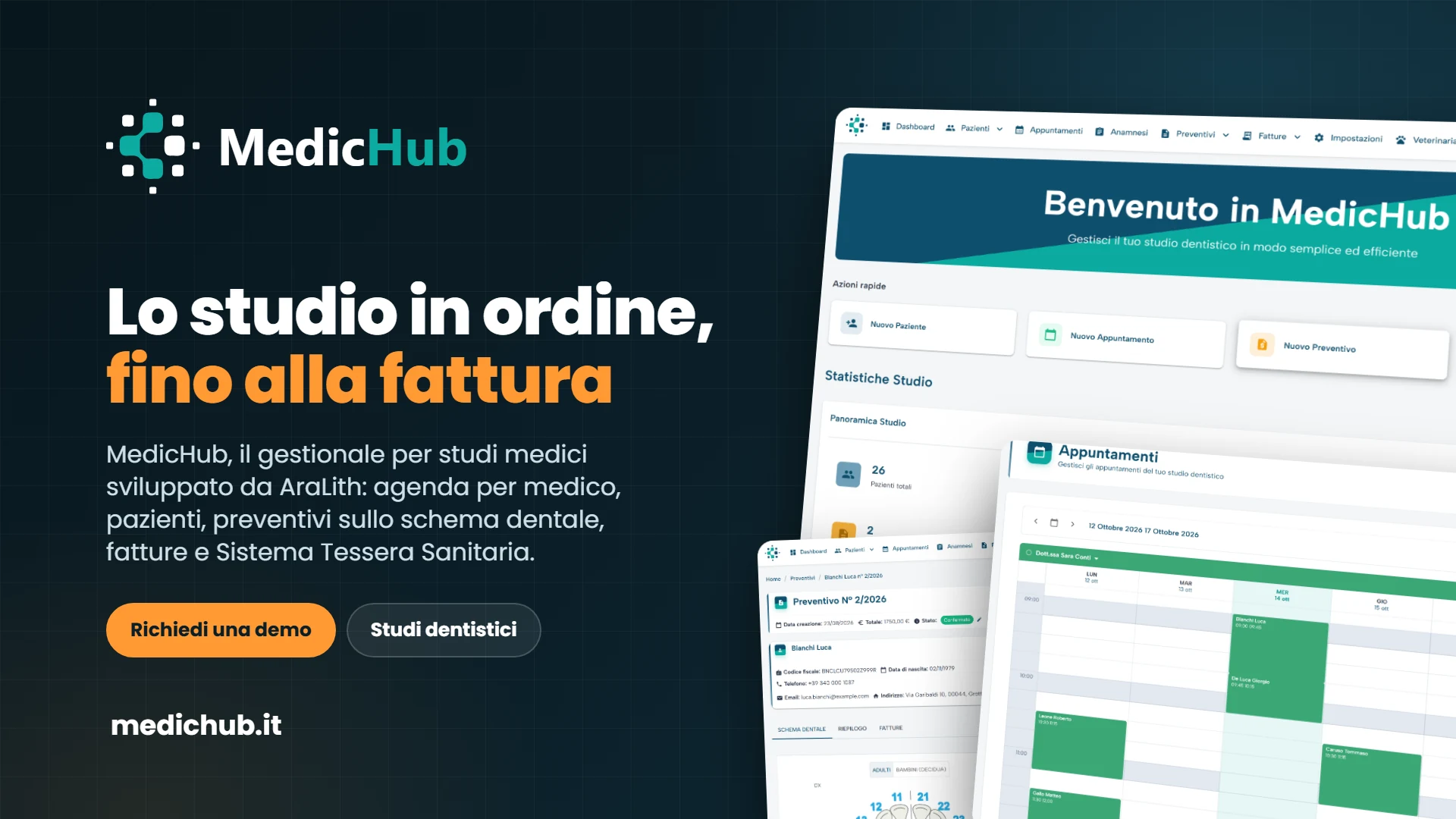
MedicHub, the management software for medical practices developed by AraLith, neither contains nor calls artificial intelligence models and performs no clinical functions: no diagnoses, treatments or image analysis. It exposes an MCP server with 29 tools, to which the practice can connect an external assistant of its own choice, with patients referred to as «patient N» and writes to be confirmed in the management software.
Artificial intelligence cannot replace the dentist: in Italy, AI systems in healthcare are a support in prevention, diagnosis, treatment and therapeutic choice, and the decision always stays with medical professionals (Law no. 132 of 23 September 2025, Art. 7(5)).
The accuracy of X-ray analysis with artificial intelligence depends on the tool, on the data it was validated with and on the type of lesion: there is no single figure. The reference for the practice is the documentation from the medical device manufacturer, with the intended purpose and the clinical evaluation required by Regulation (EU) 2017/745; every result must be validated by the clinician.
The safety of patient data depends on how the artificial intelligence tool is integrated: health data is a special category of personal data (GDPR, Art. 9) and the practice remains the data controller. Check where the processing takes place, the contract with the provider (Art. 28), minimisation and pseudonymisation (Art. 25) and any impact assessment (Art. 35).
The patient has the right to be informed: Italian Law no. 132 of 23 September 2025, Art. 7(3), states that the data subject has the right to be informed about the use of artificial intelligence technologies. The law does not specify the form or method of the information, which is best defined with your own privacy consultant.
Training for people who use artificial intelligence is required by the AI Act: providers and deployers of AI systems take measures to ensure a sufficient level of AI literacy among their staff (Regulation (EU) 2024/1689, Art. 4). A practice that uses an AI tool is a deployer.
MedicHub includes no artificial intelligence features: it neither contains nor calls AI models and does not make diagnoses, suggest treatments or analyse images. It exposes an MCP server to which the practice can connect an external assistant of its own choice, with the same permissions as the management software; the full story is in the MedicHub case study.
We design custom software with the experience of the MedicHub MCP server: permissions, pseudonymisation and writes to confirm. The first technical call is free.
Content created with the support of artificial intelligence.
